The restoration of man by the worship of God.
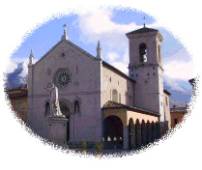
Monastero di San Benedetto in Norcia
The international Benedictine monastic community of Maria Sedes Sapientiae was founded in Rome on September 3, 1998. The birth of St. Benedict then inspires the rebirth of his followers today, and the Holy Rule he wrote then is a gift of the Holy Spirit in the hands of his disciples today.
Monastero di San Benedetto in Norcia
Via Reguardati, 22
06046 Norcia (PG)
The Very Rev. Cassian Folsom, OSB, prior of the Monastero di San
Benedetto in Norcia
Monastery History
The international Benedictine monastic community of Maria Sedes Sapientiae was founded in Rome on September 3, 1998. At the end of the Great Jubilee Year, on December 2, 2000, at the invitation of the Archbishop of Spoleto-Norcia, the community moved to Norcia, and took up residence at the birthplace of Saints Benedict and Scholastica. In the crypt of the basilica, where, according to tradition, the holy twins were born, the walls of a pre-Christian basilica can be seen, dating to the first century A.D. In this holy place, where the monks chant the Office seven times a day and once at the end of the night, it is easy to connect with the tradition. Returning to the spirit of the founder, as Vatican II urged, is as natural as breathing. The everlasting hills that surround Norcia were there when St. Benedict was a youth, when he received his human and Christian formation and was exposed to the spiritual riches of the monastic tradition by contact with the many hermits in the area. The birth of St. Benedict then inspires the rebirth of his followers today, and the Holy Rule he wrote then is a gift of the Holy Spirit in the hands of his disciples today. "What can be sweeter to us, beloved brethren, than this voice of the Lord inviting us? Behold, in His loving kindness the Lord shows us the way of life" (RB, prol.19-20).
The Inspiration for the New Monastery
1. The restoration of man by the worship of God;
2. The radical gift of self to Jesus Christ in the
monastic way of life according to the Rule of St. Benedict: Nihil amori Christi
praeponere (RB 4:21);
3. The common life of brothers as described in the
Acts of the Apostles (they were of one heart and one mind);
4. Full monastic observance, including vigils and
fasting;
5. The integration of prayer, study and work;
6. Liturgical life: a. Divine Office as prescribed
in the Rule
b. Mass and Office in Latin, sung in
Gregorian chant;
7. Love of the Church: a. Cultivation of the
attitude sentire cum ecclesia;
b. Drinking deeply from the streams of
the living tradition;
c. Fidelity to the Magisterium, filial
devotion to the Holy Father;
d. A truly "catholic", i.e.
universal spirit, acquired from studying in Rome, at the heart of the Church;
8. Apostolic work, our contribution to the new
evangelization: intellectual, clerical and manual work in the service of the
universal Church; pastoral care of the Basilica of San Benedetto, Norcia;
9.
Marian
consent: openness to the will of God after the model of Mary's fiat.
For More
Information, Please Contact:
Very Rev.
Cassian Folsom, O.S.B., Prior
Address:
Monastero di
San Benedetto
Via Reguardati,
22
06046 Norcia
(PG)
Telephone: (0743) 81.71.25
Fax: (0743) 82.84.25
Email: monastero@osbnorcia.org
The Very Rev. Cassian Folsom, OSB, prior of the Monastero di San
Benedetto in Norcia
Sacred Signs and Active Participation at Mass
By The Rev. Cassian Folsom, OSB
Father Cassian Folsom is a Benedictine monk who is Vice-rector of Sant Anselmo and
Pro-President of the Pontifical
Liturgical Institute in Rome. The following essay was Father Folsom's address to the Adoremus Conference held in Los Angeles on November 22,
1997.
What Do These Actions Mean, and Why Are They So Important?
About ten years
ago, I had the rare good fortune to spend two weeks on Mount Athos in Greece:
the Holy Mountain as they call it. I remember standing in the back of one of
the churches, prayingãwhen a young man came in with his little son: maybe three
or four years old. The man had brought his son with him on pilgrimage to the
Holy Mountain.
There was an
icon of Our Lady in the church, as there always is. It was a particular style
of Marian icon, however, called "Our Lady of the Sweet Kiss", because
the child Jesus is reaching up to his mother Mary in a tender embrace.
This man walked
up to the icon of Our Lady, made the customary reverence (a profound bow, so as
to be able to touch the ground with your fingers as a sign of humility)ãand
then he lifted up his son to kiss the icon.
Now the little
boy had learned to kiss the members of his family, not with small, silent
kisses, but with great big kisses that were very loud indeed. And thatπs how he
venerated the icon. He gave a loud smack to Christ, the wisdom and power of
Godãand then he gave a loud smack to the Mother of God, she who holds Divine
Wisdom in her arms. When the kiss of the little boy was joined to the kiss of
the Christ child, the Spirit of God entered powerfully into that church, and I
worshipped in reverence and in awe.
Adoremus: come,
let us adore the Lord, for it is He who made us! In the monastic office, thatπs
the invitatory antiphon for Sunday Vigils: Adoremus Dominum, qui fecit nos. In this conference, I would like to
talk about the attitude of love and reverence thatπs necessary for adoration.
More specifically, Iπll be talking about sacred signs and gestures that we use
in the Holy Sacrifice of the Mass.
What does
"active participation" mean?
But before I
begin with the Mass itself, let me first describe the big picture for you: this
will set the stage for what follows. The big picture is the well-known
expression "active participation" at Mass. What does that mean?
First of all,
it means the interior participation of all the powers of the soul in the
mystery of Christπs sacrificial love. Participation, in the first place, is
something interior; it means that your mind and heart are awake, alert and
engaged.
Secondly,
participation involves exterior action: saying things and doing things. What
Iπm going to focus on today, are the bodily gestures and sacred signs we use in
the course of the Mass. So weπre talking about the relationship between soul
and body in liturgical prayer.
This theme is
an important one, because modern man, it seems to me, has lost this sense of
the unity of his being: the unity of body and soul, of the interior man and the
exterior man.
A famous
theologian of the earlier part of this century, Romano Guardini, was already
talking about this problem in the 1920πs. He said: "The agent acting in
the liturgy, the one who prays and offers, is not `the soulπ or `the interior
spiritπ but man. Itπs the whole man which carries out liturgical activity. The
soul, to be sure, but only insofar as it gives life to the body. The interior
spirit, to be sure, but only insofar as it manifests itself in the body."
We have a hard
time getting this right. Either we act as if the body is everything (which is
one of the great temptations of our day) or we act as though there is a great
divorce between body and soul and the body is of no account at all. Remember,
the ultimate goal for the Christian is not the immortal soul, but the
resurrected body! So the problem of the relation between body and soul remains.
We may poke fun at the ancients for not always getting it right, but modern man
is in no better shape; in fact, heπs much worse. Modern man boasts of the power
of his intellect, desperately searches for the sensual pleasure of the body,
and forgets his soul altogether. Itπs a rare thing when a person succeeds in
integrating mind, soul and body into the unity of what the human person is
called to be: "man fully alive", as St. Irenaeus says.
Now, why am I
talking about all this? Because these problems show themselves in the liturgy.
The solution, according to Romano Guardini, is liturgical formation. He says:
"Filled as we are with the negative formation of the spirit of the age, we
must learn once again to live our religion as `men fully aliveπ. That is, we
must learn to pray with our body also. The way we carry ourselves, our gestures
and actionsãthese things must become spontaneously religious in themselves. We
must learn to express our interiority exteriorlyä we must become capable once
again of living in a world of symbols."
I am convinced
that we can rediscover these things in our own Catholic tradition. In fact, if
we can learn these things and live them out in practice, weπll be making a
significant contribution to the new evangelization. How many young people of
the West have looked to the religions of the Far East for some kind of
experience of God? Such people are willing to follow a rather strict discipline,
to remain seated for hours, back straight, without moving, all for the sake of
meditation. But the richness of prayerãeven mystical prayerãis our Catholic
inheritance: like a treasure box filled with amazing and precious gemsãbut
alas, often shut, locked, the key rusting on a hook and the box itself pushed
into a corner and forgotten.
But we have the
key! Holy Mother Church offers us the key. And part of the treasure we will
find in the Churchπs tradition is the role of the body in both private and
liturgical prayer.
We can begin
our study of sacred signs and gestures, starting from the very beginning of the
Mass and going all the way to the end.
1.
Dipping Your Hand in Holy Water
When you come into the church building, what is the first thing
you do? Don't you dip your hand into the holy water and make the sign of the
cross? Why do you do that? Well, for three reasons:
a. in
repentance for your sins;
b. for
protection against the Evil One;
c. to remind
you of your baptism.
a. Holy water
reminds us to be sorry for our sins. When there is the rite of sprinkling in
the liturgy, we always sing the Asperges, which means "you will sprinkle or wash". Asperges
me hysoppo et mundabor; lavabis me et super nivem dealbabor. These are words from the great
penitential psalm, Ps 50: You will sprinkle me with hyssop and I shall be
cleansed: you will wash me, and I shall be made whiter than snow.
b. Holy water
is a sacramental which is a protection against the snares of the devil. The old
prayer for the blessing of holy water said: "O God, creator of unconquered
power, King of invincible empire and victor ever-great: who put down the powers
of hostile dominion and conquer the fury of the roaring enemy, who fight
powerfully against our wicked foes: trembling we beseech you, O Lord, we
implore you and beg you: that you might graciously look upon this creature of
water and salt, kindly illumine it, sanctify it with the dew of your loving
kindness, so that wherever it is sprinkled, through the invocation of your holy
Name, every infestation of the unclean spirit be cast out, and the terror of
the poisonous serpent be driven far away. And may the presence of the Holy
Spirit deign to be with us always, we who implore your mercy."
c. Holy water
reminds us of our baptism: of that great day when we ourselves or our parents
or sponsorsãrenounced Satan, professed faith in Christ, and were baptized into
the mystery of the Holy Trinity. At that moment all our sins were forgiven:
original and actual, and we became children of God, filii in Filio, heirs of the promise, daring now to
call God our Father.
When you dip
your hand into the holy water font, remember these things, and like Our Lady,
treasure them in your heart.
2. Sign
of the Cross
Then you make the sign of the cross. Do it deliberately. Not
hurriedly, not sloppilyãbut carefully and with reverence. The deepest mysteries
of our faith are contained here.
Let me return
once again to the story I told you at the beginning about Mount Athos.
While there, I
had occasion to talk with a young Greek layman, who pointed out to me that
Catholics make the sign of the cross backwards. Thatπs not the most ecumenical
way to put it! But thereπs something behind what he said. You know how the
Byzantine tradition makes the sign of the cross: with the thumb, forefinger and
middle finger held together and the last two fingers held together against the
palm.
The three
fingers symbolize the Trinity, and the two fingers symbolized the double nature
of Christ: divine and human. Making the sign of the cross then, becomes a
mini-catechesis, a self-reminder of the most basic mysteries of our faith.
But the way of
holding your fingers is not the only difference. The eastern tradition makes
the sign of the cross from right to left, whereas we make it from left to
right. Why?
Itπs
interesting to note that in the 13th century, Pope Innocent III (contemporary
with St. Francis of Assisi) instructed the faithful on the meaning of the sign
of the cross in these words: "The sign of the cross is made with three
fingers, because the signing is done together with the invocation of the
Trinity. This is how it is done: from above to below, and from the right to the
left, because Christ descended from the heavens to the earth, and from the Jews
(right) he passed to the Gentiles (left)."
Note that Pope
Innocent is describing what the custom was in the West. In the 13th century the
East and the West still made the sign of the cross in the same way. The pope
goes on to say: "Others, however, make the sign of the cross from the left
to the right, because from misery (left) we must cross over to glory (right),
just as Christ crossed over from death to life, and from Hades to Paradise.
[Some priests] do it this way so that they and the people will be signing
themselves in the same way. You can easily verify thisãpicture the priest
facing the people for the blessingã when we make the sign of the cross over the
people, it is from left to right."
So the people,
imitating the blessing of the priest, began to sign themselves from left to
right. Be that as it may, centuries have gone by since then, and we in the West
make the sign of the cross from left to right, with the palm open.
Hereπs an
important liturgical principle: it is always difficult and often undesirable to
jump back across the centuries to some ideal liturgical practice of the past.
Thatπs what Pius XII in Mediator Dei called "archeologism". You canπt erase the
intervening centuries. The principle rather is continuity with the tradition
(mind you, Iπm not saying a fossilized tradition, but a living tradition). So
the Western way of making the sign of the cross is a valid development of the
liturgical tradition.
When we make the
sign of the cross, are we aware of its meaning? Listen to what Guardini says
about this: "When we cross ourselves, let it be with a real sign of the
cross. Instead of a small cramped gesture that gives no notion of its meaning,
let us make a large unhurried sign, from forehead to breast, from shoulder to
shoulder, consciously feeling how it includes the whole of us, our thoughts,
our attitudes, our body and soul, every part of us at once, how it consecrates
and sanctifies us. It does so because it is the sign of the universe and the
sign of our redemption. On the cross Christ redeemed mankind. By the cross He
sanctifies man to the last shred and fibre of his being."
In the liturgy,
there are many occasions when we make the sign of the cross:
Ä with holy water before Mass begins
Ä at the beginning of
Mass itself
Ä at the Gospel:
"may the Lord purify my understanding, my speech, and my heart, so that I
may receive the words of the Gospel".
Ä we make the sign of
the cross in the rite of baptism, for anointing the sick, for exorcisms, when
we pray throughout the day
Ä in the Divine Office,
we make the sign of the cross when we begin the Benedictus and the Magnificat, because they are Gospel canticles,
and the Gospel stands for Christ Himself.
In the library of SantπAnselmo in Rome, a place where I
spend a good deal of time, there is a fine mosaic floor showing the cross of
Christ, surrounded by the words: Ave Crux, Spes Unica. Hail O Cross, our only hope! The
cross of Christ is indeed our only hopeãthere is salvation in no other name. So
when we make the sign of the cross, which we do many times each day, letπs do
it well!
3.
Genuflecting Before the Blessed Sacrament and Bowing Before the Altar
Whatπs the next thing you do as you enter the Church? You
walk to your pew, and if the Blessed Sacrament is reserved on the altar, you
genuflect; if itπs reserved somewhere else, you make a profound bow to the
altar. Iπll say something about kneeling later. Here we are talking about a
gesture of greeting, a kind of salute. I mentioned both genuflecting and
bowing. Whatπs the difference?
Thereπs a
traditional distinction thatπs very useful: a distinction using three Greek
words: latria, hyperdulia, dulia. These three categories indicate different grades of
reverence due to God and the saints. Latria means
adoration: it is reserved to God alone. Dulia means reverence; it is given to the
saints and to sacred objects. Hyperdulia means "extra special reverence". There is only
one person in this category: Mary the Mother of God, since she is above all the
saints by the glorious design of Divine Providence.
Latria,
hyperdulia, dulia.
When we reverence the altar ã and the altar always represents Christãwe are
showing honor to a sacred object. That means dulia. So we bow. When we reverence the
Blessed Sacrament, however, we are adoring God Himself, since the Lord is truly
present in the Blessed Sacrament. That means latria. So we genuflect.
Let me say something
about both of these gestures.
Bowing
There are three kinds of bows. (I hope all these
distinctions arenπt confusing. In fact, theyπre rather useful).
a. Thereπs the
simple bow of the head that we use at the Name of Jesus. During the Mass, that
head bow is also used at the Name of Mary, and at the Name of the Holy Father.
b. Thereπs a
medium bow of the head and the shoulders. In monasteries we use that bow to
greet another monk in order to honor the presence of Christ in our brothers.
That is, when we process into choir, as we get to the center and split doff to
go to our choir stalls, after bowing to the altar we bow to one another: a
medium bow.
c. Then there's
a profound bow, bending the entire body at the waist, touching the knees with
the palms of the hand. That bow is used when the deacon asks the priest for a
blessing before reading the Gospel, when a monk asks the abbot for a blessing,
or in the Liturgy of the Hours, whenever there is a Glory Be. At the doxology
after every psalm, all the monks in choir make a profound bow in honor of the
Trinity. This comes from the Rule of St. Benedict, where he says: "After
the third lesson (he's talking about one of the nocturnes of Vigils) let the
cantor intone the Gloria Patri, and as soon as he beings, let all rise in honor
and reverence for the Most Holy Trinity." (RB 9).
For guests who
aren't accustomed to monastic ceremonial, it's a very impressive thing to see
all the monks in choir practically disappear into the choir stalls as they all
make a profound bow for every doxology. Another instance for this kind of
bowãas I mentionedãis whenever we pass in front of the altar, as a way of
saluting Our Lord, for the altar always represents Christ.
Try it next
time you pass in front of the altar (that is, if the Blessed Sacrament is not
there). Bend right in two, all the way down. Slowly, reverently. It is the Lord
Himself you are greeting.
Genuflectingãa
"half-kneel"
This gesture is related to kneeling, but you can think of it
as a quick kneel, or a "half-kneel", since you only bend one knee,
not both, and immediately get up again. When I say "a quick kneel", I
don't mean that you should do it in a hurry! Sometimes when people go into
their pew, you see them make a little bob that vaguely resembles a
genuflection. No. Put that knee all the way down to the floor, and let it rest
there for a moment. Keep your back straight, and for balance, you might want to
place both hands on your other knee. You might want to practice at home, and
teach your children to make this gesture well.
Now, my
suggestion to practice genuflecting may seem silly ã but actually these bodily
gestures have become foreign to us, and we need to re-learn them with a new
deliberateness. To do it well, you have to be conscious of what you're doing.
We have to be taught.
You know after
the consecration of both the Host and the Chalice, the priest genuflects in
adoration. The Holy Father nowadays has a hard time doing that, as many older
people do, because of arthritis or a once-broken hip or some other physical
difficulty. For Pope John Paul, it costs him something to genuflect. But he
grips the altar bravely, and forces his aching bones to bend all the way down
to the floor. And then the Master of Ceremonies helps him back up. Why does he
go to so much pain and trouble? Because of love. He loves the Lord present in
the Blessed Sacrament. If the Holy Father makes this gesture at such great
personal cost, can we who are healthy do any less?
4.
Standing to Begin Mass
After you make your preparation for Massãwhether kneeling or
sitting in the pewãthe bell rings, and you stand for Mass to begin. What does
this gesture of standing mean?
Allow me to
refer to Guardini again. In his book called Sacred Signs, he describes this situation:
When you are
sitting down to rest or chat, and someone to whom you owe respect comes in and
turns to speak to you, at once you stand up and remain standing so long as he
is speaking and you are answering him. Why do we do this? In the first place to
stand up means that we are in possession of ourselves. Instead of sitting
relaxed and at ease we take hold of ourselves; we stand, as it were, at
attention, geared and ready for action. A man on his feet can come or go at
once. He can take an order on the instant, or carry out an assignment the
moment he is shown what is wanted.
The posture of
standing, then, is a sign of respect, reverence before God. In addition, it
means that we are to ready respond to Him subito, sempre, e con gioia as Chiara Lubich, the foundress of
the Focolari Movement says. That means "right away, always, and with
joy." We stand as Mass begins. We stand for the Gospel. During the Divine
Office, we stand for the Benedictus and the Magnificat, because these are
Gospel canticles, and we are aware of the Lord's presence in a more intense
way.
To stand was
also the normal posture for Jewish prayer, and the posture characteristic of
Christian prayer as well. In the catacombs of Santa Priscilla, there's a famous
frescoãstill visible after all these centuriesãof a person in the orans positionãstanding, the garments
falling in noble folds, with arms outstretched. In fact, this is the symbol of
the Pontifical Liturgical Institute in Rome, where I live and work: Ecclesia
Orans, the praying
Church.
As many of you
are aware, the posture of standing is a posture typical of the Easter season:
standing is a sign of the Resurrection. In fact, the ancient discipline of the
East prohibits kneeling on Sundays and during the Easter season. That's good to
know. But there's the same principle at work here as we saw when talking about
the sign of the cross. To be aware of the liturgical traditions of other rites
is always useful, but it does not mean that we should ignore the legitimate
developments of our own tradition.
I have heard
that in some places in this country, people are being told that they can't
kneel during the Eucharistic Prayer. Well, this can be understood from the
point of view of comparative liturgy and the history of the liturgy, but our
western tradition has developed in a different way, and these developments have
their own value.
The rubrics of
the editio typica ã
the official Latin edition of the Missalãindicate that kneeling is the proper
gesture at the consecration. When the English Sacramentary first came out, the
Bishops' Conference of the U.S. decided that for American Catholics, kneeling
was in order for the entire Eucharistic Prayer. And that rubric has never been
changed.
But I'm getting
ahead of myself. We're talking about standing.
When you stand
at Mass, don't slouch over, don't fidget. Stand up straight and be still.
"Be still and know that I am God", as the Psalm says. Some time ago,
I remember observing one of the priests in the sanctuary during the long
reading of the Passion on Palm Sunday, which lasts probably 10 or 15 minutes.
He stood perfectly still the whole time, and didn't move a muscle. I was
impressed by his reverence. Practice standing up straight without unnecessary
fidgeting about. It's not easy! But it's a way that we can honor Our Lord.
5.
Beating the Breast
Next we come to the Confiteorãalthough unfortunately this
option of the Penitential rite is not always used. During the words mea
culpa, mea culpa, mea maxima culpa, there is the gesture of striking the breast. This is a
sign of repentance, of humility, like the parable of the Pharisee and publican
in the Gospel:
"But the
tax collector, standing far off, would not even lift up his eyes to heaven, but
beat his breast, saying: O God, be merciful to me a sinner!" (Lk 18:13)
In the Missal
of Pius V, the rubric for this gesture was very specific: "He strikes his
breast three times, saying: mea culpa, mea culpa, mea maxima culpa." The rubric
in the Missal of Paul VI is less precise. It simply says: "Striking
themselves on the breast they say mea culpa, mea culpa, mea maxima culpa." To make matters more
confusing, in the English translation, the words are not repeated three times,
but only once:
"I confess
to Almighty God, and to you my brothers and sisters, that I have sinned through
my own fault, in my thoughts and in my words, in what I have done and in what I
have failed to do."
The gesture is
still there, although both words and gesture have been much reduced. The words
express our repentance verbally. Striking the breast expresses our repentance
physically, in body language.
Guardini has
something to say about this gesture too. He asks the question:
What is the
significance of this striking the breast? All its meaning lies in its being
rightly done. To brush one's clothes with the tip of one's fingers is not to
strike the breast. We should beat upon our breasts with our closed fists. In
the old picture of Saint Jerome in the desert he is kneeling on the ground and
striking his breast with a stone. It is an honest blow, not an elegant gesture.
To strike the breast is to beat against the gates of our inner world in order
to shatter them. This is its significance.
Perhaps we should
take this gesture more seriously than we ordinarily do. In monastic
spirituality, there is an ancient tradition called penthos in Greek, or compunctio in Latin: a profound attitude of
repentance for our sins, and not only for our own, but also for those of the
whole world. St. Benedict says: "We know that our prayers will not be
heard on account of many words, but because of purity of heart, compunction,
and tears" (RB 20:3). In another place, he says: "During Lent, let us
guard ourselves from every vice, and dedicate ourselves to prayer with tears,
to reading, to compunction of heart and to fasting" (RB 49:4).
Perhaps someone
will object: those are fine sentiments for the olden days, for a spirituality
of centuries gone by, but it's not suitable for today! Pius XII once said that
the overriding sin of our twentieth century is a loss of the sense of sin. And
Pope John Paul II quotes this saying of Pius XII in his apostolic exhortation
Reconciliation and Penance.
It's true. We
as a people, and we as Catholicsãhave lost the sense of sin. The gesture of
striking the breast, made carefully and with full awareness, can communicate to
ourselves and to others more than mere words can say, that we recognize our
sinfulness and publicly declare our sorrow for our sins.
I remember
visiting a traditional monastery not too long ago, where all the monks who are
not priestsãwere kneeling in choir just before Communion. The deacon chanted
the Confiteor, and when he got to the words mea culpa, mea culpa, mea maxima
culpa, the thunder
of a multitude of monks all beating their breast at the same time shook the
complacency of my heart. Try it yourself. The rib cage is like an echo chamber.
If you strike your breast properly, you'll hear the sound of it: like the sound
of thunder.
6.
Sitting
After the penitential rite, you sit down. This means
something too. "The posture of sitting is proper to the bishop who teaches
and to the head of the community who presides." That is why the bishopãor
the abbotãhas a chair, a cathedra. The word cathedral, strictly speaking, means the place
where the bishop's chair is.
When I was a
junior monk, I remember passing through the Abbey Church on my way from one
place to another. A group of tourists was visiting the church, and some of the
youngsters, just for the fun of it, were taking turns sitting in the abbot's
chair. I saw this from a distance, and it disturbed me greatly. Obviously,
these young people meant no harm, and did not understand the significance of
the abbot's chair. But it symbolizes his authority, his person. The same thing
applies to the chair of the bishop. So sitting, on the part of the superior, is
a posture of authority for the sake of teaching.
St. Augustine
describes this in some of his sermons. He would sit on his cathedra, and the people would stand to
listen. In fact, until modern times, chairs or pews were not thought of in
designing churches. The people stood, as they do to this day in the Byzantine
tradition. But standing for a long time is tiring, and requires real
discipline. Toward the end of the Middle Ages, the practice of sitting during
certain moments of the Mass become more widespread. By the time this country
was founded, the practice was standard, so all the Churches built here have
pews or chairs. But if you visit various cathedrals and other churches in
Europe, you see that it wasn't always so.
Now, when we
sit down for the readings, the posture of being seated signifies attentive listening,
readiness to be instructed. When you sit down during Mass, remember that you're
not sitting in your living room, you're not sitting in a lounge chair or a
"Lazy-Boy". Sit up straight, quietly, reverently. Don't fidget, be
still! To listen carefully to the Sacred Scripture requires energy and
attention, and our posture should reflect that interior attitude of alertness:
listening with the ear of the heart, as St. Benedict says.
If this applies
to the people in the pew, how much more does it apply to those who are in the
sanctuary! The Ceremonial of Bishops says that "when the bishop is seated,
if he is wearing liturgical vestments, unless he is holding the crozier, he
should place his palms on his knees." Here's another principle to keep in
mind: what is legislated for the superior generally holds for the subject as
well. Try sitting that way: quietly, prayerfully, upright. If you're not
holding a book (or correcting small children), place your hands on your knees,
palms down. You'll see what a difference it makes.
7.
Folding Your Hands
Now we've come as far as the Gospel. We stand for the
Gospel, as I mentioned earlier. We make a triple sign of the cross with our
right thumb. Then what? What do you do with your hands? How about keeping them
folded?
After the
Council, as a reaction against rubrics that were perhaps too specific in a kind
of exaggerated way, the pendulum swung to the other extreme, and nobody
bothered about rubrics anymore. From a high degree of formality in the liturgy,
we changed to a style that is extremely casual. This perhaps corresponds also
to a style that is typically American: being casual is the order of the day. In
fact, clothing styles go to a great deal of trouble in order to seem casual.
That means that there are rigid unwritten laws about being causalãa great
irony, isn't it? In any case, we see this casualness also in terms of folding
our hands.
There are two
basic ways of doing this: with the fingers interlockedãor with the fingers
straight, palm to palm. This is what the Caeremoniale Episcoporum, published in 1985, says about
folding your hands. There's a paragraph entitled De manibus iunctis (Concerning folding the hands), and an explanation in a note at
the bottom of the page that says:
"When it
says with hands folded, it is to be understood in this way: palms extended and
joined together in front of the breast, with the right thumb over the left in
the form of a cross" (#107, n.80)
When we were in
grade school, the nuns would explain this business about how to hold your
thumbs by repeating the saying of the New Testament: "mercy over
justice" ãwhich is a very fine spiritual interpretation of a simple
gesture.
Guardini has
something to say about the gesture of folding your hands, explaining two ways
of doing so.
When we enter
into ourselves and the soul is alone with God, our hands closely interlock,
finger clasped in finger, in a gesture of compression and control.
So this way of
holding your hands can be a sign of intimate and personal prayer to God.
Our hands take
the same position when some dire need or pain weighs heavily on us and
threatens to break out. Hand then locks in hand and the soul struggles with
itself until it gets control and grows quiet again.
So the same
gesture can mean intensity and fervor of personal prayer. But in the liturgy,
the gesture is different. Guardini says:
But when we
stand in God's presence in heart-felt reverence and humility, the open hands
are laid together palm against palm in sign of steadfast subjection and
obedient homage, as if to say that the words we ourselves would speak are in
good order, and that we are ready and attentive to hear the words of God.
Guardini
describes other gestures of prayer with the hands (hands uplifted in prayer,
for example), and urges his readers to a deeper awareness of the meaning of
these gestures. He says:
The Church is
fully in earnest in the use she makes of the language of gesture. She speaks
through it her inmost mind, and God gives ear to this mode of speaking. Our hands
may also indicate the goods we lack, our unchecked impulses, our distractions,
and other faults. Let us hold them as the Church directs and see to it that
there is a real correspondence between the interior and exterior attitude.
Do you see how
much meaning is contained in the simple gesture of folding your hands? Be
conscious of what you are doing next time, and teach your children the same. It
will become a habit of reverence. If your hands are folded properly in prayer,
the external posture will have a positive influence on the interior man as
well, and you will be led to a profound attitude of prayer.
8.
Kneeling for the Eucharistic Prayer
After the Gospel and the homily (if there is one that day),
after the Preparation of the Gifts, the Great Prayer, called "the
Canon" or "the Eucharistic Prayer", begins. During this time we
kneel. Since this gesture has a somewhat complicated history, it's worth
spending some time on it.
The meaning of
this gesture of kneeling is manifold:
Ä humble submission before the majesty of
God
Ä penance and a spirit
of repentance
Ä adoration and
reverence in prayer
The use of this posture in the Mass developed gradually.
a. In a seventh
century document, the Ordo Romanus I, it says that during the Canon only the Pope stood upright,
while all the others in the sanctuary remained bowed for the entire Eucharistic
Prayer. The sign for standing upright again was the phrase nobis quoque
peccatoribus near
the end of the Canon: that was the sign also for the deacon and subdeacon to go
about their preparations for communion. In fact, in the old Mass, that phrase
was said out loud while the rest of the Canon was said quietly, as a remnant of
the ancient practice of bowing during the Canon.
b. From the ninth
century onward, there is historical evidence for the posture of kneeling during
the Canon. The Synod of Tours (813) described this as the characteristic
posture of the faithful, although for Sundays and feasts, it was the custom to
stand.
c. In the
thirteenth century, because of developments in Eucharistic theology and various
movements of Eucharistic devotion, the practice of kneeling at the consecration
became the norm.
d. In 1502, the
Ordo Missae of
John Burckhard prescribes kneeling for the prayers at the foot of the altar,
and for the consecration. Our present rubricsãby way of the post-Tridentine
liturgical booksãhave their origin in this Ordo Missae of Burckhard.
The history of
this gestureãwhether in liturgical prayer or in private prayerãis rather
complex. For our purposes today it is enough to stress the importance of doing
it well. Guardini says:
"Let not
the bending of our knees be a hurried gesture, an empty form. Put meaning into
it; to kneel, in the soul's intention, is to bow down before God in deepest
reverence."
The bodily
posture of kneeling is above all a sign of reverence for Christ present in the
Eucharist.
Which reminds
me of a story I must tell you. In January 1993, I was serving as substitute
chaplain at a small Catholic college in New England. It snows there, and that
particular winter there was lots of it. The Blessed Sacrament is reserved not
only in the main church, but also in the chapels of the two dorms.
Now, during the
Christmas vacation, since no one is around, the Blessed Sacrament is removed
from the dorm chapels, and when the students come back, it is brought back
again. So I was walking with the Blessed Sacrament from the church to the
girls' dorm, covering the pyx with my cope, because it was windy and cold. An
altar server with his candle accompanied the Blessed Sacrament.
As we
approached the door of the girls' dorm, two of the students happened to be
coming out at the same time. They weren't expecting us, but as soon as they saw
that I was carrying the Blessed Sacrament, without a moment's hesitation, they
knelt down in the snow in honor of Christ present in the Eucharist. That
gesture made a profound impression on me.
In these our
days, when the Catholic understanding of the Eucharist is often very weakãwhen
there are some people who don't even know what it is that they receiveãit is
imperative that we show by our gestures the faith we believe. Actions speak
louder than words! So let us kneel. Flectamus genua. Carefully, deliberately, reverently.
That will reinforce our own belief in the Real Presence of Christ, it will
teach our children by example, it will inspire our fellow Catholics, and it
will scandalize a world that does not believe.
9.
Walking up to communion
After the Eucharistic Prayer and the Great Doxology, it is
time for communion. How do you get from your pew to the sanctuary? You have to
walk. Now, it's not as self-evident as it seems. How to walk with dignity, to
process? Guardini addresses this question also.
Walking. How
many people know how to walk? It is not hurrying along at a kind of run, or
shuffling along at a snail's pace, but a composed and firm forward movement.
There is spring in the tread of a good walker. He lifts, not drags, his heels.
He is straight, not stoop-shouldered, and his steps are sure and even.
When I was a
novice, we were taught how to walk in procession so that we would keep even two
by two, and so that the line would stay straight. It was particularly difficult
to keep together when making a turn, because the monk on the outside would have
to walk faster than the monk on the inside, so as to keep together. Anyone who
has done any marching knows that: marching in a band, or in the armed services,
or in a parade.
At the time of
my novitiate, we all thought that being taught how to walk was ridiculous.
"You'd think a grown man would know how to walk!" we exclaimed in our
pride and ignorance. But the fact of the matter was, we didn't know how to walk
properly. The Novice Master was right: we had to be taught.
When you walk
up to communion, don't look all around you this way and that. Concentrate on
what you are about to do, on whom you are about to receive. With this kind of
walking, you draw near to presence of God. Be conscious of what you are doing,
and walk with calm reverence and a spirit of recollection and prayer.
10.
Receiving Communion
Once you arrive at the sanctuary, what then? It depends, of
course, on how the church is designed, whether you kneel at the altar rail to
receive communion, or receive standing. I would like to say a few words about
receiving on the tongue or receiving in the hand.
It's true that
the more ancient way of receiving communion was in the hand. Listen to what St.
Cyril of Jerusalem (fourth century) has to say about this.
"After
this, ye hear the chanter, with a sacred melody, inviting you to the communion
of the Holy Mysteries and saying: O taste and see that the Lord is good. Trust
not the decision to thy bodily palate; no, but to faith unfaltering; for when
we taste we are bidden to taste, not bread and wine, but the Body and Blood of
Christ.
Approaching, therefore, come not with thy wrists
extended, or thy fingers open; but make thy left hand as if a throne for thy
right, which is about to receive the king. And having hollowed thy palm,
receive the Body of Christ, saying after it, Amen. Give heed lest thou lose any
of it; for what thou losest is a loss to thee as it were from one of thine own
members. For tell me, if any one gave thee gold dust, wouldest thou not with
all precaution keep it fast, being on thy guard against losing any of it, and
suffering loss? How much more cautiously then wilt thou observe that not a
crumb falls from thee, of what is more precious than gold and precious
stones?"
Think of it! You are about to receive the Lord God Himself.
Be on your guard, therefore, against any lack of reverence.
Here is a very
practical point. Those who are ordained may take the Holy Eucharist themselves.
Those who are not ordained receive the Eucharist; they never take it. Don't
reach for it, wait until the Body of Christ is given to you. And take to heart
the words of the centurion: "Lord, I am not worthy that you should come
under my roof, but speak only a word, and my soul shall be healed".
Along with
sentiments of unworthiness there should be sentiments of joy and gladness. For
as the psalm says (Ps 35).
How precious
is thy steadfast love, O God!
The children of men take refuge in the shadow of thy
wings.
They feast on the abundance of thy house,
and thou givest them drink from the river of thy
delights.
The ancient way of receiving communion in the hand gradually
changed, however, as a response to occasions of abuse. For with communion in
the hand, it is easy to slip the host into your pocket or your purse and,
whether with innocent or evil intent, commit sacrilege.
By the early
middle ages the custom had changed, and communion on the tongue was the rule.
Here again, we have to be taught. Some people barely open their mouths, and it
is difficult for the priest to place the host on their tongue. Some people open
their mouth too wide and stick out their tongue too far, and there is the
danger that the host will fall off onto the paten or, God forbid, onto the
floor.
Let's avoid
both extremes! Open your mouth wide enough and extend your tongue far enough so
that the priest can place the host easily on your tongue.
Be aware of
what you are doing. Remember the vision of Isaiah the prophet:
"In the
year that King Uzziah died, I saw the Lord sitting upon a throne, high and
lifted up; and his train filled the temple. Above him stood the seraphim; each
had six wings; with two he covered his face, and with two he covered his feet,
and with two he flew. And one called to another and said: "Holy, holy,
holy is the Lord of hosts; the whole earth is full of his glory." And the
foundations of the thresholds shook at the voice of him who called, and the
house was filled with smoke. And I said: "Woe is me! For I am lost; for I
am a man of unclean lips, and I dwell in the midst of a people of unclean lips;
for my eyes have seen the King, the Lord of hosts! Then flew one of the
seraphim to me, having in his hand a burning coal which he had taken with tongs
from the altar. And he touched my mouth and said: `Behold, this has touched
your lips; your guilt is taken away, and your sin forgiven'." (Is 6:1-7)
The Holy Eucharist is a burning coal, which the seraphim
places upon your tongue. It will sear your heart with its heat, and you will be
inflamed with the blaze of Divine Charity.
A
Reminder
Now, I've said nothing new, I've told you nothing you don't
know already. This has been just a reminderãboth to me who speaks, and to you
who listenãthat the sacred signs and gestures of the Mass have a great power to
open us up to the holiness of God.
Since by Divine
Providence, we are gathered for this conference in the City of the AngelsãLos
Angeles ã perhaps the angels can teach us something about restoring
reverence to the liturgy. I want to let St. Benedict have the last word: listen
to what he says about reverence in prayer and the holy angels.
We believe that
the divine presence is everywhere and that in every place the eyes of the Lord
are watching the good and the wicked (Prov 15:3). But beyond the least doubt we
should believe this to be especially true when we celebrate the divine
[mysteries].
We must always
remember, therefore, what the Prophet says: "Serve the Lord with
fear" (Ps 2:11), and again: "Sing praise wisely" (Ps 46:8); and
"In the presence of the angels I will sing to you" (Ps 137:1). Let us
consider then, how we ought to behave in the presence of God and his angels.
(RB 19).
Rev. Cassian
Folsom, OSB
Pontificio
Istituto Liturgico
S. Anselmo,
Rome
© Adoremus Bulletin, Adoremus Society for
the Renewal of the Sacred Liturgy, P.O. Box 3286, St. Louis, MO 63130, (314)
863-5858.
Sign of
the Cross
Issue: What are the history and significance of the sign of
the cross?
Response: The sign of the crossãan immemorial Christian
custom first mentioned in writing at the beginning of the third
centuryãsignifies the grace of redemption and strengthens us (cf. 1 Cor.1:23).
Discussion: The Catechism of the Catholic Church discusses
the sign of the cross in the context of its treatments of the Second
Commandment and the Sacrament of Baptism.
The Christian begins his day, his prayers, and his
activities with the sign of the cross: ≥in the name of the Father and of the
Son and of the Holy Spirit. Amen.≤ The baptized person dedicates the day to the
glory of God and calls on the Saviorπs grace which lets him act as a child of
the Father. The sign of the cross strengthens us in temptations and
difficulties (no. 2157).
The sign of the cross, on the threshold of the celebration [of the
Sacrament of Baptism], marks with the imprint of Christ the one who is going to
belong to him and signifies the grace of the redemption Christ won for us by
his cross (no. 1235, emphasis in text).
The first written mention of the sign of the cross occurs in
Tertullianπs fascinating discussion of unwritten Tradition (De Corona Militis,
A.D. 204). Tertullian describes the sign of the cross as a long-established
custom:
And how long shall we draw the saw to and fro through this
line, when we have an ancient practice, which by anticipation has made for us
the state, i.e., of the question? If no passage of Scripture has prescribed it,
assuredly custom, which without doubt flowed from tradition, has confirmed it.
For how can anything come into use, if it has not first been handed down?ä At
every forward step and movement, at every going in and out, when we put on our
clothes and shoes, when we bathe, when we sit at table, when we light the
lamps, on couch, on seat, in all the ordinary actions of daily life, we trace
upon the forehead the sign (Chapter III, emphasis added).
Numerous texts from the next three centuries demonstrate
that the sign of the cross was a widespread practice in the early Church. These
texts are summarized in The Catholic Encyclopedia (1912):
Thus St. Cyril of Jerusalem in his Catecheses (xiii, 36)
remarks: ≥let us then not be ashamed to confess the Crucified. Be the cross our
seal, made with boldness by our fingers on our brow and in every thing; over
the bread we eat and the cups we drink, in our comings and in goings; before
our sleep, when we lie down and when we awake; when we are travelling, and when
we are at rest.≤
The course of development seems to have been the following.
The cross was originally traced by Christians with the thumb or finger on their
own foreheads. This practice is attested by numberless allusions in Patristic
literature, and it was clearly associated in idea with certain references in
Scripture, notably Ezech., ix, 4 (of the mark of the letter Tau); Ex., xvii,
9-14; and especially Apoc., vii 3; ix, 4; xiv, 1. Hardly less early in date is
the custom of marking a cross on objectsãalready Tertullian speaks of the
Christian woman ≥signing≤ her bed (cum lectulum tuum signas, ≥Ad uxor.,≤ ii, 5)
before retiring to rest-and we soon hear also of the sign of the cross being
traced on the lips (Jerome, ≥Epitaph. PaulÊ≤) and on the heart (Prudentius,
≥Cathem.,≤ vi, 129). Not unnaturally if the object were more remote, the cross
which was directed towards it had to be made in the air. Thus Epiphanius tells
us (Adv. HÊr., xxx, 12) of a certain holy man Josephus, who imparted to a
vessel of water the power of overthrowing magical incantations by ≥making over
the vessel with his finger the seal of the cross≤ pronouncing the while a form
of prayer. Again half a century later Sozomen, the church historian (VII,
xxvi), describes how Bishop Donatus when attacked by a dragon ≥made the sign of
the cross with his finger in the air and spat upon the monster.≤ All this
obviously leads up to the suggestion of a larger cross made over the whole
body, and perhaps the earliest example which can be quoted comes to us from a
Georgian source, possibly of the fourth or fifth century. In the life of St.
Nino, a woman saint, honored as the Apostle of Georgia, we are told in these
terms of a miracle worked by her: ≥St. Nino began to pray and entreat God for a
long time. Then she took her (wooden) cross and with it touched the Queenπs
head, her feet and her shoulders, making the sign of the cross and straightway
she was cured≤ (Studia Biblica, V, 32).
In the sixth century, the sign of the cross came to be made
with two fingers (the index finger and middle finger, or the thumb and the
index finger) as a confession of Catholic teaching that Christ had two wills
and two natures. Later, the sign of the cross was made with three fingers (the
thumb, index finger, and the middle finger) to confess the Blessed Trinity,
while the ring finger and little finger pressed against the palm signified the
two natures and wills of Christ.
In both East and West, the sign of the cross was made from
right to left until the Middle Ages. Father Cassian Folsom, O.S.B., President of
the Pontifical Liturgical Institute, explained the development of the current
Western practice (left to right) in a 1997 talk:
Itπs interesting to note that in the thirteenth century,
Pope Innocent III (contemporary with St. Francis of Assisi) instructed the
faithful on the meaning of the sign of the cross in these words: ≥The sign of
the cross is made with three fingers, because the signing is done together with
the invocation of the Trinity. This is how it is done: from above to below, and
from the right to the left, because Christ descended from the heavens to the
earth, and from the Jews (right) he passed to the Gentiles (left).≤
Note that Pope Innocent is describing what the custom was in
the West. In the thirteenth century the East and the West still made the sign
of the cross in the same way. The pope goes on to say: ≥Others, however, make
the sign of the cross from the left to the right, because from misery (left) we
must cross over to glory (right), just as Christ crossed over from death to
life, and from Hades to Paradise. [Some priests] do it this way so that they
and the people will be signing themselves in the same way. You can easily
verify thisãpicture the priest facing the people for the blessingãwhen we make
the sign of the cross over the people, it is from left to right.≤
So the people, imitating the blessing of the priest, began
to sign themselves from left to right. Be that as it may, centuries have gone
by since then, and we in the West make the sign of the cross from left to
right, with the palm open.[1]
In Christifideles Laici, the 1988 apostolic exhortation on
the vocation and mission of the lay faithful in the Church and in the world,
Pope John Paul II wrote briefly of the sign of the cross:
≥Christian, be aware of your nobility!≤ Every year, on
Easter night, Christians are invited to remember their Baptism. It is like a
great collective anniversary of the Sacrament once received, as a child or as
an adult. It is an opportunity to recall a personal event which leaves an
everlasting mark on our life. It is an opportunity to relive more intensely the
commitment taken that day and revive the sap received from the true vine (cf.
Jn. 15,5). The aspersion at the beginning of Sunday Mass is also a reminder of
the Baptism received and the promise made by the Lord: ≥I will wash you with
pure water and you will be purified≤ (Ezek. 36,25). And every time we make the
sign of the cross with holy water, we are reminded as Christians of our
baptism. ≥The call to holiness is rooted in Baptism and proposed anew in the
other Sacraments, principally in the Eucharist. Since Christians are reclothed
in Christ Jesus and refreshed by his Spirit, they are åholy.π They therefore
have the ability to manifest this holiness and the responsibility to bear
witness to it in all that they do≤ (no. 16).
Most Western Christians outside the Catholic Church do not
cross themselves in prayer. The sign of the cross is a fundamental sign of the Catholic
faith, one of the first learned by a child and one of the last made before
death. Through the Cross of Jesus Christ, we are given the grace to be the salt
of the earth and the light of the world. If we are to conquer the world from
within, then let us conquer by this sign.
Wednesday, September 22, 2004
Magdalen College alumni and friends gathered
for an Alumni Reunion and celebration of the Feast Day of Mary Magdalen on July
24-25, 2004, the final event of the 30th Anniversary year celebration. Staff
and faculty welcomed 100 alumni and their families from throughout the United
States and Canada, for a weekend of activities. "It's always good to come
back," said Kathy (Hochreiter) St. Pierre '84, wife of David '83 and
mother of John '07. "It's great to see my classmates and friends,
some who we may not have kept in touch with since graduating. It is very
encouraging to meet newer alumni who are just starting their families who have
the same Faith and aspirations for their families. Even if there is a 10-15
year difference in graduation dates, we still have a lot in common. Our
children are even beginning to form friendships through this annual alumni
reunion. It's great fun!" For many alumni who graduated before 1991 from
the old campus in Bedford, NH, it was their first visit to the new campus in
Warner, NH.
The weekend began with a reception on Saturday
evening followed by an illustrated history of Magdalen College prepared by
Sarah Jane von Haack '01 and Mark Gillis '90, a tutor at the College. On Sunday
July 25, a Mass in honor of Mary Magdalen was celebrated by Very Reverend
Father Cassian Folsom, O.S.B. of the Monastery of Saint Benedict in Norcia,
Italy, a leading liturgist and long time friend of the College. After brunch,
Fr. Cassian delivered a keynote address to the alumni on "Leadership
According to the Benedictine Rule." Accompanying Fr. Cassian during his
visit was alumnus Br. Clement Suhy '98 who had professed his solemn vows in
Norcia in June 2004. Br. Clement is the first vocation of the monastery.
One
of the anticipated events of the weekend was the first annual meeting of the
newly reorganized Alumni Association. Elected as officers of the Alumni
Advisory Council were John Graveline '94 (Gaithersburg, MD), Chairman; Mary
Curley '80 (Norwood, MA), Vice Chairman; Ellen Maher '01 (Tully, NY),
Secretary; John Lindsey '03 (Washington, DC), Treasurer; and
members-at-large, Robert Edge '01 (Owensboro, KY); Fr. James Farfaglia '78
(Corpus Christ, TX), Joshua Miller '98 (Steubenville, OH); and David van Hecke
'87 (Sussex,WI). "We hope Alumni will come away from this weekend
energized to spread the good word about the College, the Program of Studies and
the many opportunities and successes an education at Magdalen has brought its
graduates," said John Graveline. "The College has been blessed since
its founding and made tremendous progress; now after 30 years, it's truly our
time to take up the challenge and help make the next 30 years a success."
Pontificio Ateneo Sant'Anselmo: Consigli delle
Facolt‡ e Docenti
(aggiornato l'8 ottobre 2004)
CONSIGLI
DELLE FACOLT¿
Facolt‡ di
Filosofia
Mons. Molinaro
Aniceto
R.P. Bucher
Gregor, osb
R.D.
Castellazzi Vittorio Luigi
Prof. De Santis
Andrea
D. Miranda de Almeida
RogÈrio, osb
R.P. Salmann
Elmar, osb
R.P. Casetta
Giuseppe, osb vall
Facolt‡ di Teologia
R.P. Sheridan Mark, osb, Decano della Facolt‡ di Teologia
R.Sr. Bˆckmann
Aquinata, osb
R.P. Collins
Gregory, osb
R.P. Driscoll
Jeremy, osb
Rev.mo P. Engelbert
Pius, osb
R.D. G‰de
Gerhard
Prof. Grillo
Andrea
R.P. Hombergen
DaniÎl, ocso
R.P. Paciolla
Sebastiano, o cist
Prof.ssa
Perroni Marinella
R.Sr. Pfeifer
Michaela, o cist
R.P. Puglisi
James, sa
R.P. Regan
Patrick, osb
R.P. Salmann
Elmar, osb
R.P. Schmidt
Albert, osb
R.P. Simon
L·szlÛ, osb
R.P. SimÛn
Alfredo, osb
R.P. Stadelmann
Andreas, osb
R.D. Visintin
Stefano, osb
Pontificio Istituto Liturgico
R.P. Flores
Arcas Juan Javier, osb
R.P. AugÈ
Matias, cmf
R.P. Carr
Ephrem, osb
R.D. De Zan
Renato
R.P. Folsom
Cassian, osb
R.P. Leachman
James, osb
R.P. Leikam
RubÈn, osb
Prof.ssa
Militello Cettina
R.P. Nin Manel,
osb
Prof. Parenti
Stefano
R.P. Pecklers
Keith, sj
R.D. Ramis
Gabriel
R.P. Scicolone
Ildebrando, osb
R.D. Tymister
Markus
Mons.
Valenziano Crispino
Prof.ssa
Velkovska Elena
DOCENTI
Facolt‡ di Filosofia
R.P. Bucher
Gregor, osb
R.P. Casetta
Giuseppe, osb vall
Prof. De Santis
Andrea
Prof. Grillo
Andrea
D. Miranda de
Almeida RogÈrio, osb
Mons. Molinaro
Aniceto
R.Sr. Pfeifer
Michaela, o cist
R.P. Salmann
Elmar osb
Prof. Schwibach
Armin
R.P. SimÚn
Alfredo, osb
R.P. Stadelmann
Andreas, osb
R.P. Zielinski
M. Christofer, osb silv
Prof. Zupi
Massimiliano
Emeriti:
R.P. B¸ki
Gabriel, osb
R.P. Hoegen
Maternus, osb
Facolt‡ di Teologia
Mons. Alwan Hanna, ml
R.D. Barban,
Alessandro, osb cam
R.D. B‰renz
Reinhold
Rev.mo P.
Bargellini Emanuele, osb cam
Prof. Bemporad,
Jack
R.Sr. Bˆckmann
Aquinata, osb
R.P. Carr
Ephrem, osb
R.P. Collins
Gregory, osb
Prof.ssa Debanne
Alessandra
R.P. Driscoll
Jeremy, osb
R.P.
Feldk‰mper, Ludger, svd
R.D. Gallagher,
Raphael, cssr
R.D. G‰de
Gerhard
Past. Genre
Ermanno
Prof. Grillo
Andrea
R.P. Hidber
Bruno, cssr
R.P. Hombergen
DaniÎl, ocso
Rev.mo P.
MalfËr Benno, osb
Prof.ssa
Mazzolini Sandra
R.P. Meiattini
Giulio, osb
Prof.ssa
Militello, Cettina
R.Sr. Natali
Maria Laura, osb
R.P. Nin Manel,
osb
R.P. Paciolla
Sebastiano, o cist
Prof.ssa
Perroni Marinella
R.Sr. Pfeifer
Michaela, o cist
R.P. Pott
Thomas, osb
R.P. Puglisi
James, sa
R.P. Regan
Patrick, osb
Past. Ricca
Paolo
R.P. Salmann
Elmar, osb
Prof.ssa Scanu
Maria Pina
R.P. Schmidt
Albert, osb
R.P. Sheridan
Mark, osb
R.P. SimÛn
Alfredo, osb
R.P. Simon
L·szlÛ, osb
R.P. Skeb
Matthias, osb
R.P. Stadelmann
Andreas, osb
R.D. Visintin
Stefano, osb
Emeriti:
R.P. Lafont
Ghislain, osb
R.P. Rouillard
Philippe, osb
R.P. Studer
Basil, osb
R.P. Tragan
Pius-Ramon, osb
Rev.mo P. Zakar
Polykarp, o cist
Onorari:
R.P. Penco
Gregorio, osb
R.P. Raquez
Olivier, osb
R.P. Vog¸È
Adalbert de, osb
Pontificio Istituto Liturgico
R.Sr. Aguirre
Maria Dolores, ccv
R.P. AugÈ
Matias, cmf
Arch.
Baciarlini Andrea
R.D. Barba
Maurizio
Prof. Bemporad
Jack, Rabb
Prof.ssa Bonney
Gillian
Mons. Busani
Giuseppe
R.P. Calabuig
Ignazio, osm
R.P. Carr
Ephrem, osb
R.P. Castellano
Jes˙s, ocd
R.D. Cescon
Bruno
R.D. De Zan
Renato
R.P. Flores
Arcas Juan Javier, osb
R.P. Folsom
Cassian, osb
R.P. Francis
Mark, csv
R.D. GarcÌa
Cordeiro JosÈ Manuel
R.D. Gatti
Vincenzo
R.P. Leachman
James, osb
R.P. Leikam
RubÈn, osb
R.P. Maggiani
Silvano, osm
S.E.R. Mons.
Marini Piero
Prof.ssa
Martinelli Rossella
R.D. Mazza
Enrico
R.P. Midili
Giuseppe, o.carm
Prof.ssa
Militello Cettina
Prof. Navarra
Leandro
R.P. Nin Manel,
osb
Prof. Orsola
Gianluca
Prof. Parenti
Stefano
R.P. Pecklers
Keith, sj
R.D. Ramis
Gabriel
R.P. Regan
Patrick, osb
R.P. Rupnik
Marko I., sj
R.P. Scicolone
Ildebrando, osb
R.D. Tymister
Markus
Mons.
Valenziano Crispino
Prof.ssa
Velkovska Elena
R.P. Viola
Vittorio, ofm
Professori emeriti:
R.P. Sartore Domenico, csj